
Honey Bee Swarms
We cannot offer advice or support about other insect problems such as wasps, bumble bees or solitary bees. Read more on how to help our other pollinators.
EMBA can offer advice and the collection of honey bee swarms in Edinburgh and the Lothians.
Our swarm collection service is entirely run by volunteers, and no charge is made for this service – though a donation to EMBA is always welcome!
However, most of the contact we receive about problems with bees actually turn out to be wasps, bumble bees or solitary bees.
Click this button, in the first instance to identify the type of insect you are having problems with.
Who to call if you have a swarm of honey bees.
If you have used the above app and determined you do have a SWARM of honey bees, you can contact us.
Our preferred contact method is WhatsApp.
Please send us as much information as you can, and include images/video of the swarm as possible. This will allow the fastest response.
Our Swarm Co-ordinator Matthew Richardson will contact a beekeeper local to the swarm for safe relocation.
Alternatively, you can call us:
07906 076873
Note that we may not always be available to answer calls or listen to voicemail messages.
What to do if you have a swarm of bees in a building.
If you have a problem with honey bees nesting in a property, you can contact us using the form here:
We have a couple of members with suitable insurance who can carry out this service and there will likely be a charge for time and work involved.
We cannot offer advice or support about other insect problems such as wasps , bumble bees or solitary bees.
General information about swarming
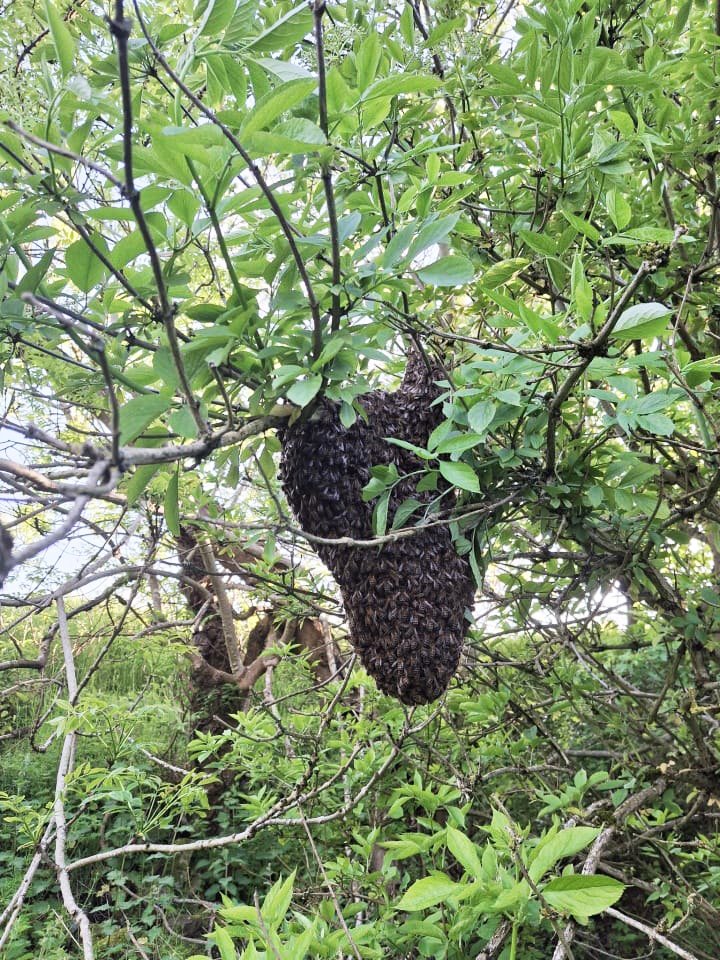
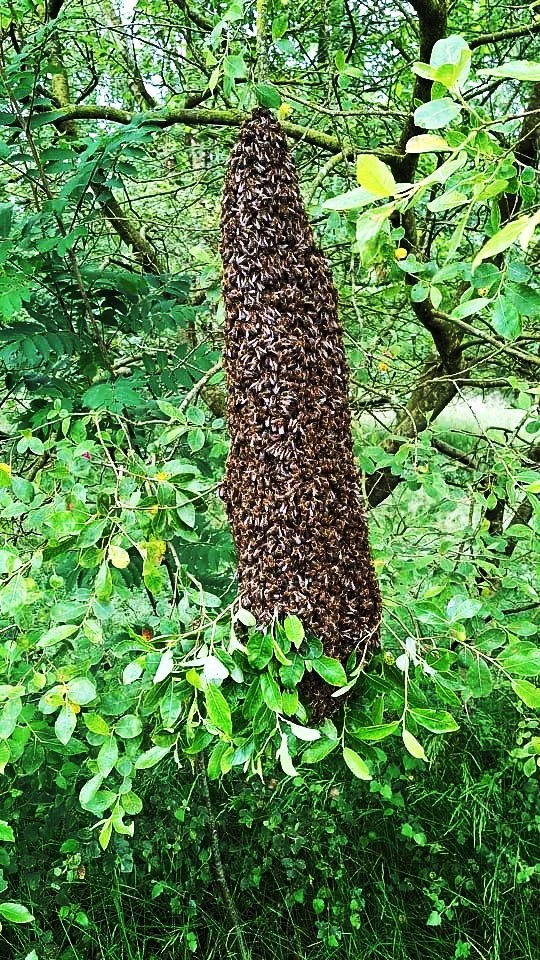
Swarming usually occurs in late spring and summer when the queen leaves the hive or nest with all the adult flying bees leaving behind enough young bees, larvae, eggs and prepared queen cells to keep the colony going. This is the natural way in which honey bees increase their numbers.
A swarm will travel to a new location and may land on trees, bushes, walls, posts or anything convenient to wait while the scouts find a new permanent home. A swarm can be an unwelcome guest when this happens.
What to do if you enounter a swarm.
If you encounter a swarm, you should take the following steps:
Keep any people, children and pets or other animals away from the swarm.
If possible, alert passers-by to the presence of the swarm so that they don’t accidentally disturb it.
Don’t do anything to provoke or disturb the swarm to try to get it to move on. The swarm will only move when it is ready to do so, and interference might result in stings!
If you need to move around near the swarm, do so in a calm, controlled manner, avoiding making any sudden movements or loud noises.