Settled For Winter by Alan Riach
The Tears of Re should all be snuggled down, quietly munching away on their bounteous (I hope) stores. Albeit on the odd 9 Celsius and above day, there are always a few intrepid adventurers still bringing in pollen. I had a cast swarm that arrived and installed itself in a Nuc box in mid-September. They have been fed since then until mid-October and seem fairly heavy.
Now is the time to plan your next season’s beekeeping. What happened in the 2026 season? Write down some notes as an aide-memoire and refer to them during the 2027 season. Could my swarm control have been better? Did I produce new queens from good stocks rather than just from colonies I was forced to artificially swarm – we don’t want to breed queens from swarm-inclined colonies! Do you need more equipment for next season?
Are you thinking of going to the heather in 2027? If so, plan to have really populous colonies ready by the 2nd or 3rd week in July. A good method of achieving this is to Pagden a colony in late May and ensure that the new queen colony has plenty of food to build up and expand through the summer. Then in the 2nd week of July, unite the two colonies back together, headed by the new queen or perhaps with the mother queen if she is only a year old. Keep the spare queen in a Poly Nuc with a small colony (Poly Nucs survive better through winter); it will, of course, need feeding for winter. The unite should give you a colony boiling over with bees and a young queen more inclined to keep laying late into the season, which is what is needed for the heather. Perhaps make yourself a Heather clearing board (bee escape(s) in a mesh screen board) to cut down the trauma of removing supers at the heather. You can insert the heather clearer board above an empty super placed above the brood box, a few days before retrieving from the heather and then remove the supers on the collection day without having bees flying everywhere.
If you are thinking of entering any of the SBA exams, consider how much study time you’ll need and if you’re going for one of the practical exams, where you might get some practical mentoring. Several of the EMBA members run mentoring classes for the SBA Basic and Junior Beekeeping exams – enquire with Fiona Dagge-Bell, the members’ officer, as to who may be doing so in 2027. There are now two extra modules available – M4 Plants and Pollinators and M9 History of Beekeeping. These don’t count towards the Intermediate or Advanced Module awards but are nonetheless interesting. There is also a planned group for Module 3 (see below).
There did not seem to be a severe June Gap last season, but the season did seem to end rather abruptly.
The last practical task for 2026 may be a Varroa treatment prior to Christmas using an oxalic acid trickle or vapour method. Remember to use adequate PPE, especially if using the vapour treatment method, and to fill in a Veterinary Products Record sheet as required legally. See Tech data sheet 12 on the SBA web pages.
For those colonies needing treatment, I usually vapour treat the week before Christmas and, for convenience, put on a 2 kg bag of fondant in the same operation. The bees most likely won’t need that until February or March, but it saves having to return to them later.
In the past, I have weighed hives monthly from November through April, just to see how the food stores decreased over winter and have been surprised to see how little change in weight occurs between mid-November and the end of February. The drop in weight then accelerates from early March, starting off slowly in early March and becoming quite rapid through April and into early May. The other interesting observation coming from these tests was that the colonies that didn’t start using food in late March and April just never built up into really strong colonies. If we could get economical electronic hive weighers, it would, in conjunction with a smidgeon of AI, be a useful tool for colony evaluation and management. Of course, hive weighing equipment does exist, but the high accuracy/stable over time load cells needed make it quite expensive.
For old-fashioned hive weighing, see Tech Data Sheet number 21 on the SBA website.
Do consider entering the EMBA Honey Show on 7th November (deadline for entries is this coming Wednesday 4th). There is an SBA Tech Data Sheet No. 26 about preparing honey for the show bench by Enid Brown.
And thinking of Christmas, time to start dropping hints to the family about “useful beekeeping items and books”. You are, after all, helping them with that difficult task of finding gifts.
The ancient Egyptians believed that bees came from the tears of the sun god Ra (Ra and Re seem to be synonyms), and this meant that bees were of supreme importance in religious terms as well as in the supply of honey and wax. The chief beekeeper reported directly to the Pharaoh, who often termed himself Ruler of the sedge and bees. The first hieroglyph for the bee appeared in 3000BC. Professor Kritsky has written an interesting book called the Tears of Re.
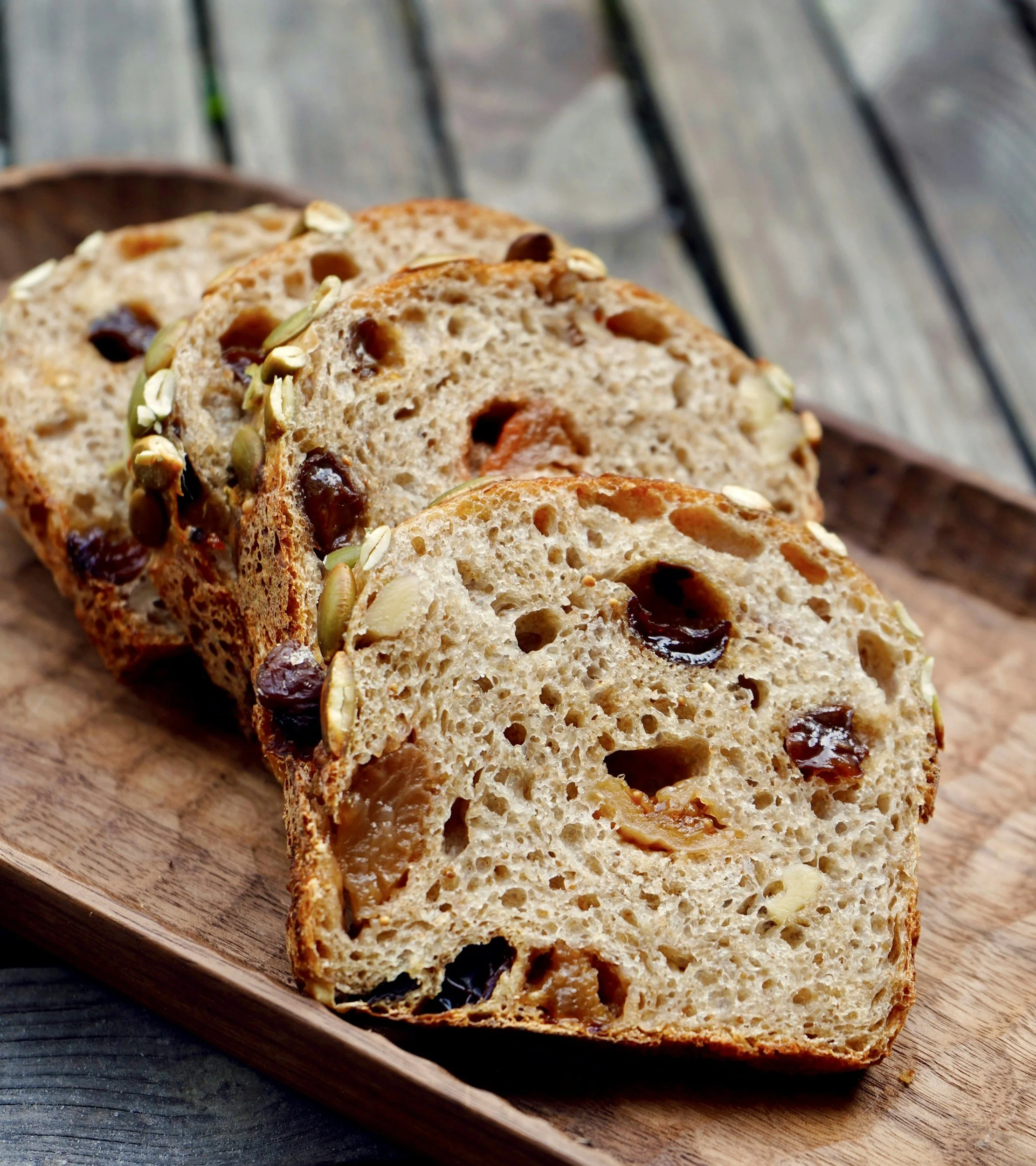
Cynthia’s Recipe for a Tea Loaf
(by popular request and as sampled by attendees at our last talk)
List of ingredients
80 g raisins
175 g currants
250 ml hot strong English Breakfast tea
260 g plain flour, 50 g demerara sugar
60 g soft brown sugar
100 g honey (set or liquid)
1 rounded teaspoon of mixed spice
10 g baking powder
1 egg
Butter or margarine for greasing tin & baking paper
Method
Put the currants and raisins in a large bowl and pour over the hot tea. Leave to soak overnight.
Add the sugars and honey to the bowl and mix well, especially if set honey is used.
Add the beaten egg.
Prepare a 900g (2 lb) loaf tin by greasing it and lining it with greased baking paper.
Preheat the oven to 150 ºC
In a separate bowl, mix the flour, baking powder and mixed spice together.
When the oven is up to temperature, add the dry flour mixture to the large bowl and mix well.
Place in the tin and bake in the centre of the oven.
Check after 1 hour using a skewer (if the skewer comes out sticky, more time is needed; return to the oven for 10 to 15 mins).
If more time is needed in the oven, cover with foil (to prevent over-browning).
Exact baking time will depend on the oven